Three Ways Additive Manufacturing is Changing Supply Chain Management
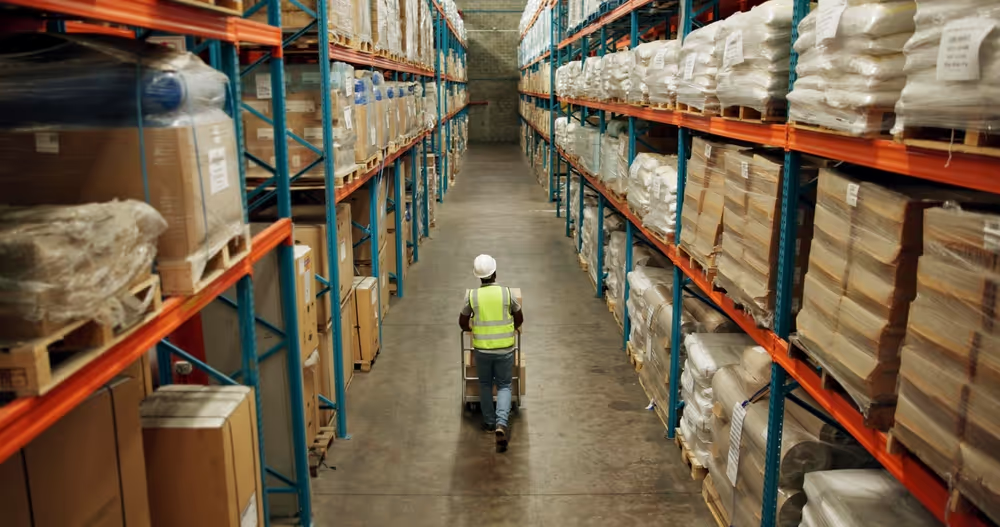


The supply chain, the sequence of steps involved in production and distribution of a product, is being changed by AM.
Companies can carry out their operations independently from customer demand, granting them the ability to manufacture parts without a minimum order batch.
According to an MIT study on the impact of 3D printing on the Global Supply Chain in 2020, the move to 3D printing allows companies to save 85% on transport costs. As there is less required, inventory costs decrease by 17%. In total, 70% of the savings were recorded across the entire supply chain. In view of these benefits, many companies are choosing to ‘go additive’ at every stage of AM production, facilitating greater process reliability and quality control production process.
A whitepaper from Global Supply Chain Institute asserts that ‘some supply chain professionals predict 3D printing will eventually rival the impact of Henry Ford’s assembly line’.
Ford’s moving assembly line allowed for the work to be taken to workers rather than the worker moving to and around the vehicle. AM allows several steps in this entire line to be skipped; the work is not merely taken to the workers, but taken to the customers themselves.
The impact of AM promises to be significant, that much is indubitable– but just how much will it impact supply chain management? Will it enhance supply chains , or is the technology set to completely revolutionise how parts are produced currently?
Theoretically, the sky is the limit. There is an appetite for it– according to a 2021 Fictiv's survey, for 84% of companies, on-demand manufacturing is believed to be a critical solution moving forward from the pandemic.
But as the last few years have evidenced, the path to widespread adoption can be a bumpy one.
In this article, we take a look at 3 ways in which AM can enhance (or revolutionise) current supply chain management. We examine how AM addresses the issues customarily present within traditional supply chains, and offer solutions to current barriers preventing AM OEMs and ISBs from scaling production even further.
Customisation

Products we have typically consumed are becoming increasingly more accessible to us as creators. The line between producer and consumer, spurred by DIY culture and a greater democratisation of information (thanks to the Internet), has spawned a greater prosumerist market. As customers, we are accustomed to instant gratification and same-day delivery, and we are more knowledgeable and informed about what we want than ever before.
AM can be a tool to support customers to meet their individual tastes and requirements. Manufacturers have the unprecedented freedom to tailor their products to specific demands and thus enhance the client experience.
Similarly, 3D printing brings an agility to the supply chain as a whole. The market is changeable, and geopolitical factors along with general customer preferences mean that companies need to be sensitive to these changes if they are to experience success (76% of customers expect personalisation, according to Zendesk Benchmark).
Traditional supply chains are lacking in their response to this current desire for customisation, and are missing out on a true competitive advantage. Through the use of AM, companies can rapidly adapt and adjust to changes in the market.
This isn’t just limited to consumer products. Healthcare often demands personalisability and customisability, as in the case of implants, orthotics and prosthetics, dental parts, medical instruments, realistic functional prototypes, and, in particular, hearing aids (check out our recent article about this application).
Almost 100% of hearing aids are now 3D printed. Along with increased cost and time efficiency, choosing AM for production in this area means leapfrogging steps in the supply chain which previously clogged up the process and prevented a device with significant beneficial implications from entering the market at the fastest speed possible.
Barrier to adoption
Although the foreseeable benefits that customisation brings are immense, the process of conversion from traditional manufacturing processes is not all plain sailing.
Time and money is required to make the change. Design for AM (DfAM) is a necessary condition for redesigning parts, as AM does not function to its full potential when CAD models designed for traditional manufacturing are used.
Any redesign will necessitate a high level of expertise and investment in testing the new design versions, and a contingent of engineers and designers to facilitate the transition. Re-training and redefinition of roles may be called for, if not the hiring of completely new staff.
But perhaps this should not be viewed as a limitation, rather an opportunity. Commercialising AM in a production context is not just a matter of ascertaining how to switch existing parts from subtractive to additive designs. Given the capabilities of AM and its power to address issues with traditional supply chain management, the process of redesigning objects and operations should be considered as a boon.
We are in the midst of Industry 4.0, and a ‘supply chain 4.0’ is the next logical step. Systems like AMFG are needed to manage the entire supply chain from beginning to end, and aid companies in scaling operations when DfAM is achieved. AMFG collaborates with HP to surmount a hurdle preventing AM to fully realise its supply chain potential: a lack of connectivity across the AM workflow.
Manufacturers can directly connect with their systems through AMFG’s software, track production status, and receive critical alerts and info in real time. Through a transfer of data at every stage of AM production, greater process reliability and quality control is facilitated, and manufacturers can prepare their supply chain management.
Inventory
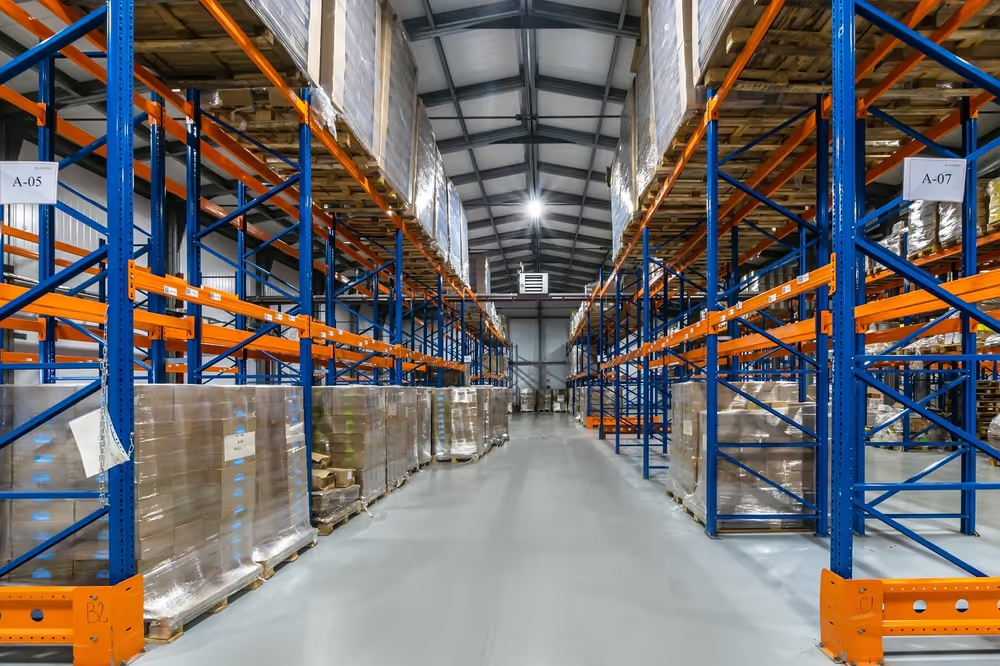
AM has the potential to revolutionise inventory and storage.
Currently, production is a fragmented process that depends on different steps in the supply chain located across the world, and is contingent on geopolitical and market factors. Static inventory systems mean that companies are susceptible to overproduction and excess inventory.
Consequently, parts run the risk of warehouse obsolescence, losing value due to prolonged time resting and then replaced by new parts at the cost of the manufacturer (and subsequently the consumer).
There may be loss of products between the purchase and sale caused by admin errors, damage during the transportation process, and theft.
Furthermore, fluidity in customer demand and the omnipresent risk posed by unforeseen circumstances demonstrate why a supply chain benefits from being agile. Geopolitical factors like tariff threats, unprecedented obstructions (for example, the Suez Canal blockage in 2021), and broader international challenges like the Covid-19 all threaten the integrity of supply chains.
In fact, 72% of companies who responded to an Ernst & Young LLP survey between 2020 and 2022 reported that the pandemic had a negative effect on their company, and all automotive and nearly all (97%) industrial products companies asserted the extent to which their supply chains were problematically impacted.
Physical inventory is the weak point in any supply chain. AM permits the creation of digital inventory and thus a digital warehouse, a revolutionary concept for Industry 4.0. Decentralised production can be laid as a foundation for a newly constructed conception of how inventory works.
Here's how AM can be beneficial for inventory:
1- Cost reduction
A digital inventory could dramatically drive down costs. Transport is not required as much, the lower number of SKUs required for production positively impacts warehousing, and companies can sidestep tariffs with greater ease.
Companies often pay premiums for stocking and storing products for a determined time, and costs accrued for orders, stock-out, and warehouse maintenance all stack up. Part obsolescence means that some parts kept in warehouses may never be used, and the share of excess inventories can sometimes exceed 20%.
Yet digitalising supply chains through AM can circumnavigate these costs. Companies can access digital CAD files and print parts when requested without needing to store these parts and risk part obsolescence.
2- Creation
Suitability to applications is the ultimate litmus test for any manufacturing process, and 3D printing succeeds on this front.
Some industries demand the type of supply chain that does not admit of physical storage so easily, and AM is perfectly suited to address these problems.
Military applications demand the ability to produce complex objects autonomously in a remote environment. AM decentralises production and allows organisations to print parts in non-traditional environments.
For example, Australian metal 3D printer manufacturer SPEE3D has been successful in proving its Expeditionary Manufacturing Unit (EMU) has the capacity to operate in sub-zero temperatures. Previously, they have shown the technology’s ability to perform well in extreme conditions during a collaboration with the Australian army in which the EMU functioned in the extreme heat of the Australian bush.
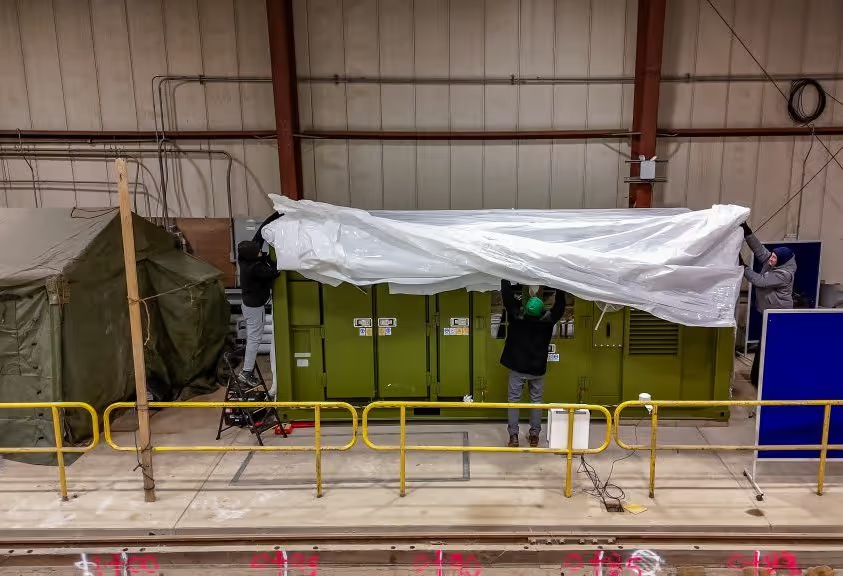
XSPEE3D being set up for cold testing in CRREL location. Image courtesy of SPEE3D
Similarly, the oil and gas industry could reap the benefits of an AM enhanced supply chain. A bank of CAD files for on-site printing in the field would speed up repairs and maintenance, reducing the need to maintain physical inventories of spare parts on site or have them transported in.
3- The future
So AM has the potential to enhance, if not completely revolutionise, supply chain management. Rapid replacement of spare parts enabled by databases replete with CAD files for usage at any point could drastically alter how processes are managed.
The future will see parts being designed for AM, but, in the interim, reverse engineering and 3D scanning could help rebuild part geometry for parts designed for traditional manufacturing.
In the past, start-ups like Kazzata have promised a radical shake-up of supply chain management, with an online marketplace for spare parts effectively establishing a CAD repository for obsolete and spare parts. In these online repositories, users can find the right part and then send the file to the nearest 3D printer.
We may even see AM be employed for end-of-runway services that integrate logistics solutions located at specific warehouses in direct proximity to important airport hubs. This would allow organisations to access the shipment of critical parts, even after latest order cut-off times.
Barrier to adoption
Like a physical inventory, a digital one must also be well maintained and meticulously managed. Creating a digital database of 3D files in shared folders is not as efficient as it could be, as manufacturers will need to download files each time they need to be printed.
This approach exhibits a lack of connectivity with a production management system that could be improved by using dedicated software to store CAD models and their production requirements.
A single system to store digital AM spare part files simplifies the location of the design file and all the necessary data about the part, like the required process and material. AMFG improves production workflows, from order placement to shipment, with seamless integration and precision automation.
Furthermore, improperly managed digital inventories run risk of falling below industry regulations surrounding security and confidentiality. AMFG recently obtained ISO 27001, the leading standard for Information Security Management Systems, integrating people, processes, and technology to ensure confidentiality of information in organisations. With contracts in high-security industries on the rise in 2025, companies who demonstrate a connected workflow will win big.
Reduction of lead times
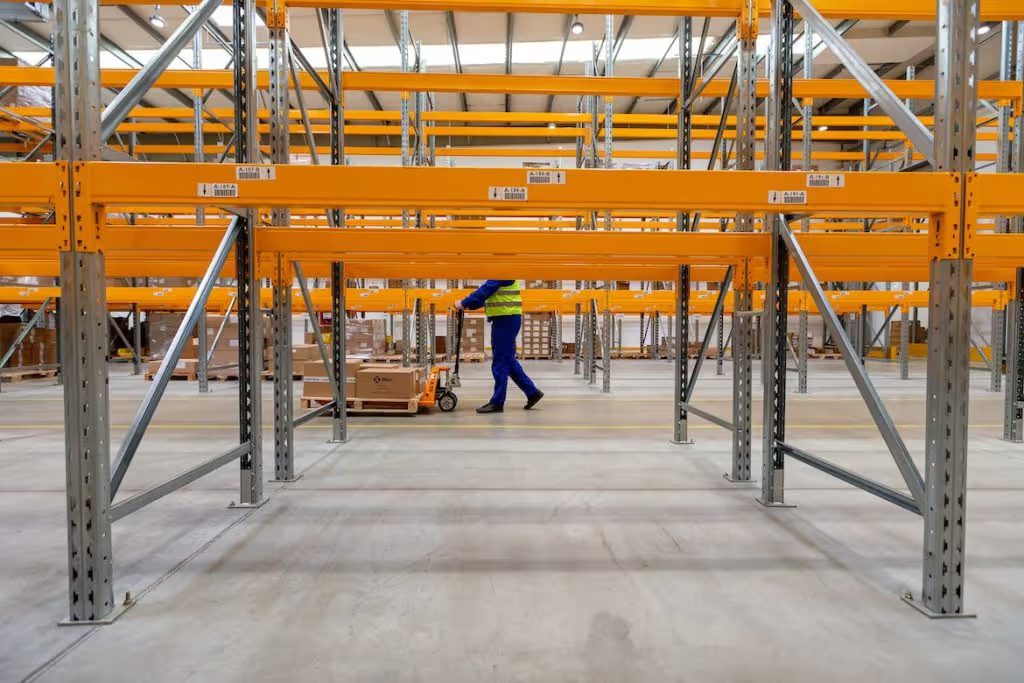
AM also significantly reduces lead times for parts, greatly benefitting supply chain management.
Thanks to the consolidation of the number of components and processes required, the supply chain is drastically shortened. Complexity is decreased, production costs are saved, and lead times are improved. Outsourcing is not as crucial as it is in traditional supply chains, as it is only required for the coating and finishing or assembly of the components themselves.
Although the actual process of printing production is relatively slow, such that hours may pass before a small batch of components is produced, the set-up compared to traditional processes is night and day. AM outstrips, for example, injection moulding as soon as you zoom out and look at the supply chain as a whole.
The current supply chain formulation is defined in terms of large distances and complicated relationships with suppliers, making it difficult for manufacturers to negotiate, monitor, and apply the supply and organisation activities. This increases transaction and coordination response, and, as a response, organisations have implemented increasingly complex supply chains lacking the agility and flexibility necessary to react to customer demand and preference.
Companies can cut time and precious resources by delivering all-in-one parts with AM. Waste can be reduced and resource consumption can be lessened, leaving room for new resource allocation.
Likewise, interoperability among different systems is becoming increasingly more pertinent. Automation in production and post-processing is an important trend, with many companies turning toward solutions in order to facilitate this.
A step towards automation signals an inclination towards a whole new supply chain management approach, where the individual steps are combined into a single process, from concept to materials, digital inventory, production, and subsequent delivery and use.
Barrier to adoption
Although AM has the potential to slash lead times by carving sections out of supply chains, some steps are still necessary.
Transportation of the raw materials themselves, like filament, still entails some challenges and therefore bears careful planning. AM depends on a consistent flow of metals, polymers, and composites to keep production lines running smoothly. Yet, as is the case with traditional manufacturing supply chains, the global picture is complicated and vulnerable, with key suppliers often located in geopolitically complex regions.
In a recent article, we discussed the potential impact of the new President's tariffs on the AM landscape, looking at opportunities for the industry. But there are also some challenges, and additive manufacturers should bear these in mind.
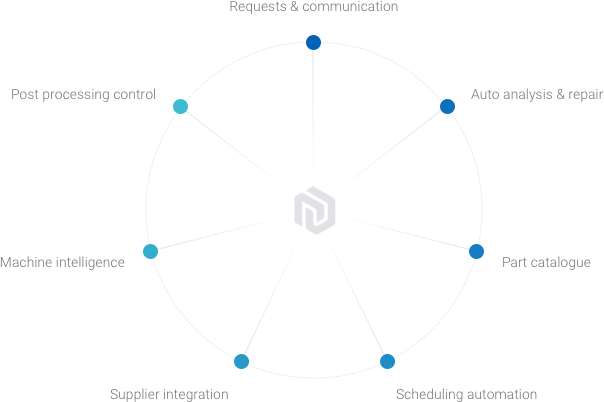
AMFG allows manufacturers to create a holistic and secure platform, ready to deal with supply chain management issues. Manufacturers can manage digital inventory, streamline shipping processes, and directly connect with preferred suppliers and subcontractors and enable on-demand, distributed manufacturing– click here to find out more:
Final thoughts
How far can AM take supply chain management? Will it revolutionise, or merely enhance existing processes?
The potential is enormous. AM can successfully respond to customer demand as it’s massively customisable and exhibits agility in the supply chain. It drastically reduces lead times and can facilitate the move from a physical to a digital inventory, thus completely restructuring supply chain management.
In the future, manufacturers can benefit from agile supply chains to rapidly adapt to changes in the market, eventually seeing design, production, and distribution merge into one supply chain with greater client involvement in the entire process. Digital warehouses containing CAD files could become the norm, reducing the problems associated with physical inventory.
As the technology develops, the logistics will follow suit. Companies could work with logistics providers to create a 3D printing network, where small micro factories located in regional warehouses or local distribution centres produce the necessary components close to the point of need and can be branded with an OEM’s label. Despite previous attempts with mixed success, we may even see the emergence of 3D printing shops and mobile vans.
AM is enhancing supply chains across the globe, but how can it move forward even further?
On a simple level, AM costs are preventing widespread adoption– for this to occur, printers need to be faster, cheaper, and more agile. Yet new materials and innovations in AM technology are already chipping away at cost per part.
Quality and cybersecurity assurance is also crucial, and manufacturers should pick partners and solutions which permit maximal information security and data protection.
Yet what is needed most is connectivity. Machine connectivity allows manufacturers to gain full visibility and process control, using data to improve AM processes and maximise efficiency.
But if AM is to completely revolutionise supply chain management, holistic collaboration is needed. Standards must be developed, printer and post-processing systems must work together to create an ecosystem in which service providers, material producers, and print farms are connected. AMFG allows OEMs and service bureaus to establish direct connections with preferred suppliers and subcontractors, empowering on-demand, distributed manufacturing.



.avif)

.svg)

Subscribe to our
newsletter