How to Avoid Downtime in Additive Manufacturing


The problem of downtime
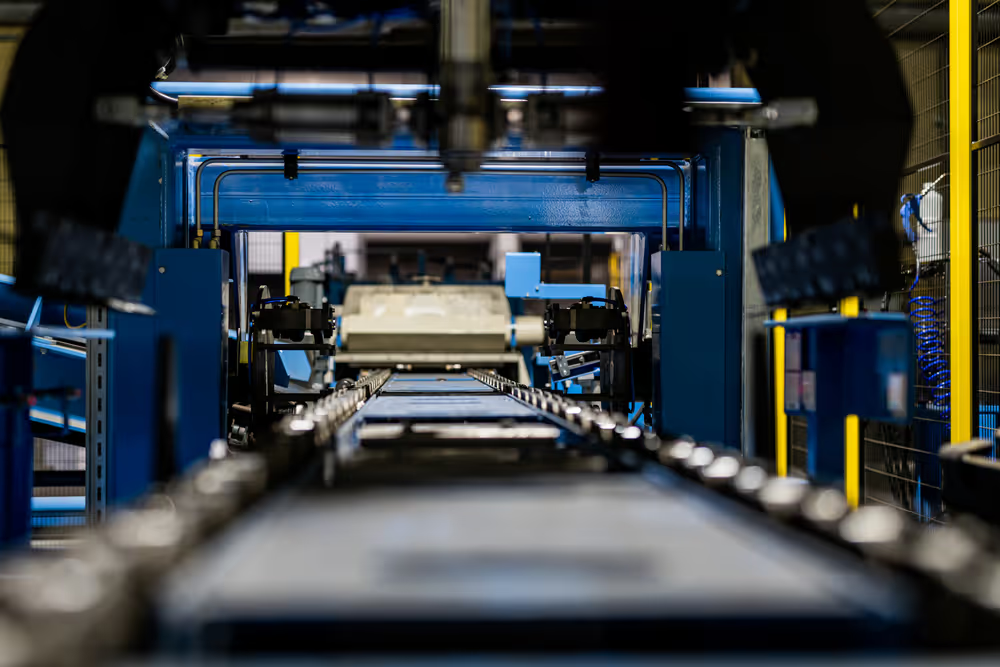
Downtime is costly. Machines are what makes manufacturers money, and if they’re out of action or unavailable, this money can’t be made.
Unplanned downtime costs US manufacturers $50 billion annually. The negative impacts are abundant and threatening in equal measure, as downtime risks scrapped materials, overtime labour, lost customers, supply chain disruptions, issues in quality, safety risks, and energy and raw material waste.
The cost of an idle line can vary according to the industry– in the food industry, the impact can be hundreds of thousands of dollars a day, yet the automotive industry could be hit with losses of $22,000 a minute per line. That’s $1.3 million an hour. Traditional approaches to maintenance in the manufacturing sector are unsustainable, particularly in the face of more effective alternatives.
How tech can help

Technology is advancing, and manufacturers have the ability to combat the effects of downtime.
AI facilitates predictive maintenance, allowing companies to foresee equipment failures. Manufacturers can identify complex, multi-variable patterns missed by traditional maintenance techniques. Real-time monitoring can be leveraged to process millions of data points per second across production facilities.
Potential intervention strategies can also be generated, with a holistic consideration of resource availability and production schedules. With AI, manufacturers are able to foster an intelligent, proactive maintenance environment.
Some forms of downtime can be completely avoided if surveillance is implemented. Along with process-related failures that lead to downtime, failures in security can result in machines going out of use. Implementation of security measures such as cameras, facial recognition, and motion detection could prevent problems before they even occur.
Finally, additive manufacturing offers a solution to challenges presented by downtime in traditional processes. With AM, manufacturers can ensure that their line is down for the absolute minimum time through decentralised production and reduction of lead times. There’s a diminished reliance on shipments from abroad, so machines aren’t waiting on external factors.
However, although AM could be a solution for the obstacles presented by idle periods, downtime could still be problematic for 3D printing companies.
Why is downtime an issue for AM?
Material waste
If downtime takes place mid-print, materials may be wasted, particularly in processes that demand continuous operation.
Production delays
Unplanned downtime can halt production schedules, leading to missed deadlines and delivery delays. If these delays impact order fulfillment, customers may lose trust and seek alternative suppliers. In general, downtime reduces overall manufacturing capacity, thus impacting the ability to scale production efficiently.
Falling behind the competition
On this note, frequently occurring downtime can mean that innovation and responsiveness to markets suffer. Customer satisfaction could be affected, a big threat for AM companies.
Increased costs and inefficiency
Idle machine waste resources, and the cost of repairs, maintenance, or replacement parts can be high. Operators and engineers may be left idle, or, at the very least, have to shift the focus of their role to troubleshooting.
Quality issues
Interrupted prints may lead to defects, requiring rework or scrapping of parts. Similarly, frequent stoppages and restarts can contribute to wear and tear on machine components, increasing the frequency with which repairs are required.
Data, software, and security issues
Some AM systems rely on cloud-based or networked software, and downtime may result in a loss of critical design files or process data. If this downtime occurs as a result of theft or destruction of equipment, then there are security-related issues that need to be addressed.
How to avoid downtime
Implement predictive maintenance
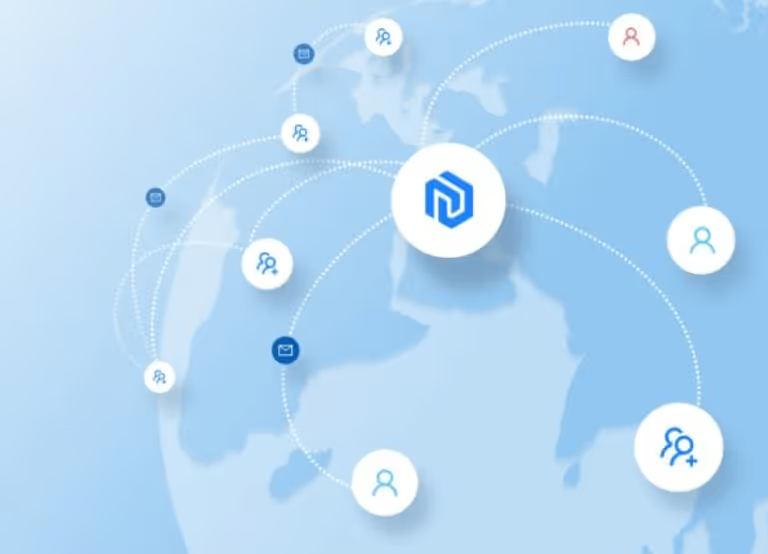
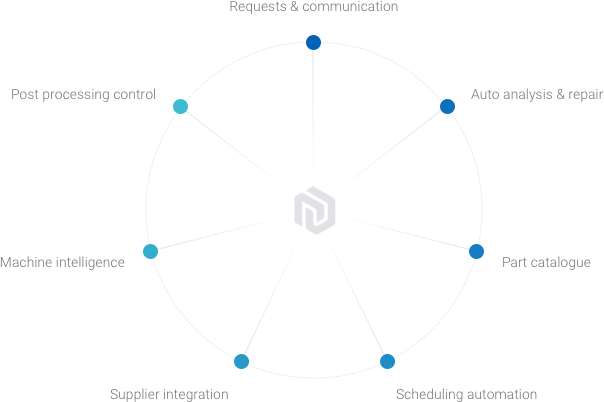
Being proactive will avoid the risks associated with downtime, rather than relying on purely reactive repairs. AMFG generates barcodes and profit from direct machine connectivity by predicting and ensuring part quality, identifying failed parts, and capturing quality data for reporting and process improvement.
Streamline production scheduling
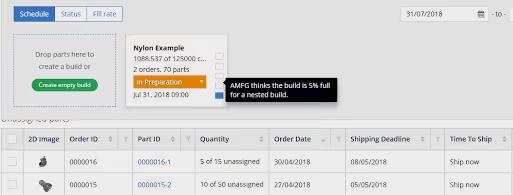
An efficient way of managing production scheduling can diminish the risk of downtime whilst speeding up lead times in the process. AMFG's automated scheduling swiftly allocates ideal production timelines for each project, reducing lead times by processing client order queues automatically.
Ensure your supply chain is visible
Transparency and traceability are essential. Ensure systems are in place that allow real-time progress updates and live material tracking , guaranteeing transparency and traceability throughout every step of the manufacturing process. Communication is key– ensure collaboration between departments and operations, deploying operators when and where necessary to avoid inefficiency and downtime.
Utilise AI to reduce the possibility of human error
We’re only human, and sometimes things go wrong. From incorrect machine setup and improper material handling, to software configuration errors and inadequate maintenance, user errors during operation can lead to downtime. Leveraging artificial intelligence and machine learning can reduce the risks and lack of efficiency associated with an idle shopfloor.
Leverage remote monitoring and control
Creating and effectively managing a digital inventory can help manufacturers avoid problems associated with downtime. Finding solutions that maintain equilibrium between efficient JIT delivery and tactical solutions can solve these issues. To ensure that machines are not left idle, inventory-level tracking and automated reordering can aid companies in keeping a constant handle over all material, machine, and resource readiness.
Respond quickly to part production failure
The time lost in responding to part defects could be put to use on other projects in the interest of accelerating efficiency and productivity. An MES system can permit live quality-assurance task tracking to easily meet regulatory requirements and industry standards, immediately locating defective parts and making sure nothing slips through the net. Production mishaps are bound to occur, but how manufacturers respond separates the good from the great.
AMFG is an award winning MES designed to empower production workflows, allowing manufacturers to avoids the risks associated with downtime. Find out more by contacting us here:


.avif)


.svg)

Subscribe to our
newsletter