Latest Developments in Additive Manufacturing: April 2025


Even for a technology as varied in scope as 3D printing, April’s developments have been numerous and diverse in nature.
Keeping up to date with innovations and trends in the additive manufacturing scene is crucial for any company in the industry. Read on to discover the latest milestone for additive construction, a transformative new 3D printed pill that could help millions, a new alternative to fish, and more!
Customised Café with 3D Printed Starbucks
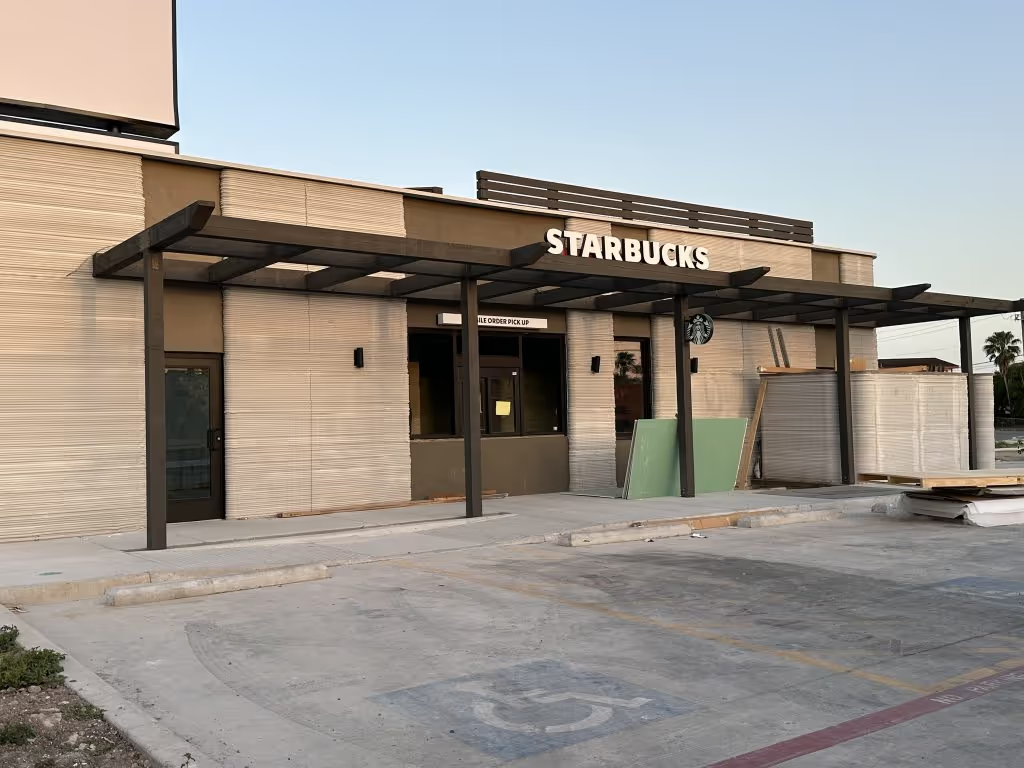
3D printed Starbucks building. Image courtesy of the Government of the City of Brownsville
The past few months have borne witness to a growing trend: the approximation of 3D printing and the construction industry.
From record-breaking restaurant interiors to 3D-printed stations in 3 hours, additive construction has been gaining traction. April saw Starbucks open its first-ever 3D printed store in the US. The coffee shop, located in Brownsville, Texas, near SpaceX’s Starbase facility, opened its doors in late April.
The building, which measures 1400 square feet (130 square metres) is a collaboration between PERI 3D Construction and COBOD International, the latter a global leader in construction 3D printing. By using concrete with/in COBOD’s BOD2 gantry-style printer, the team were able to construct the outer shell of the store directly on site in just six days.
With no indoor seating or in-store dining, and a compact size compared to other Starbucks locations, the store is designed as a drive-thru and walk-up venue. This represents a milestone for additive construction, speeding up construction and reducing waste, supporting Starbucks’ broader sustainability goals and showing what 3D printing can offer commercial spaces.
Elsewhere in construction, Dutch company Poly Products have developed a modular bridge that reuses a decommissioned wind turbine blade as its primary girder. The structure forms part of a programme which supports pilot initiatives for circular infrastructure across the Netherlands.
3D Printed Pill Promises to Improve Heart Arrhythmia Treatment
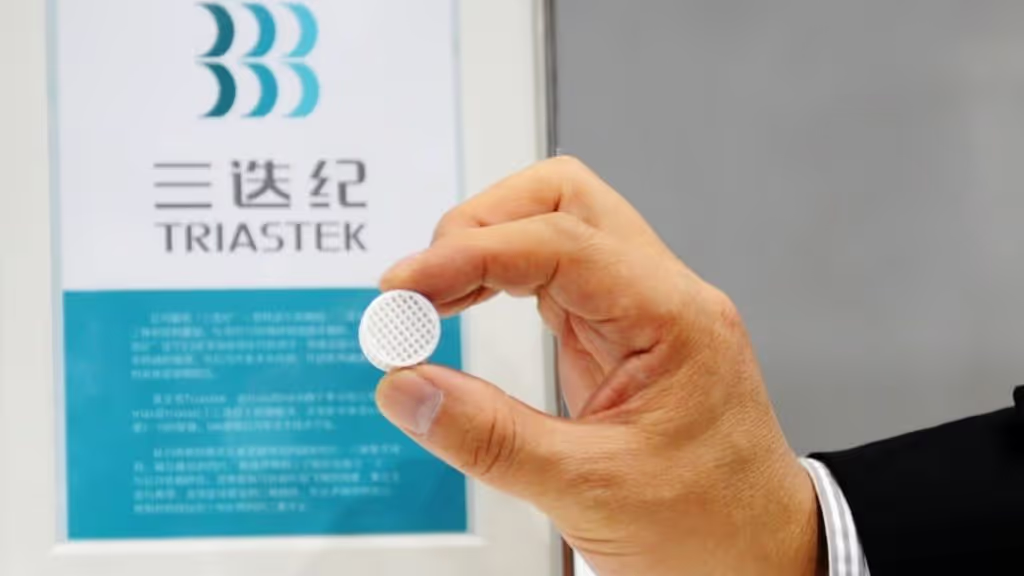
Triastek‘s T19 drug for rheumatoid arthritis. Image courtesy of Triastek
Trisatek, a Chinese 3D printing pharmaceutical company, have secured FDA approval to test a once-a-day anticoagulant pill fabricated with 3D printing. The milestone means the non-vitamin K antagonist oral anticoagulant (NOAC) named T20G has now achieved IND clearance in both China and the US, a significant development in the field of gastric retention drug delivery.
The most common type of heart arrhythmia, atrial fibrillation, plagues approximately 1-2% of the global population, with anticoagulation therapy playing a key role in preventing strokes in AF patients. For treatment, NOACs have replaced older blood thinners like warfarin, due tosuperior safety and efficacy. However, Tristatek aims to improve this by producing a pill that releases slowly in the stomach over an entire day, thus improving patient adherence and dosing convenience.
The pill has been developed with the company’s own Melt Extrusion Deposition with Micro-Injection Molding (MED&MIM) process. This technology builds the pill using melted pharmaceutical materials, allowing engineers to design complex internal structures that are not possible with standard pill-making techniques.
With this announcement, Tristatek hopes to further develop the T20G and “deliver high-quality pharmaceutical solutions to patients worldwide.”
Additively Manufactured Cod Alternative on the Market
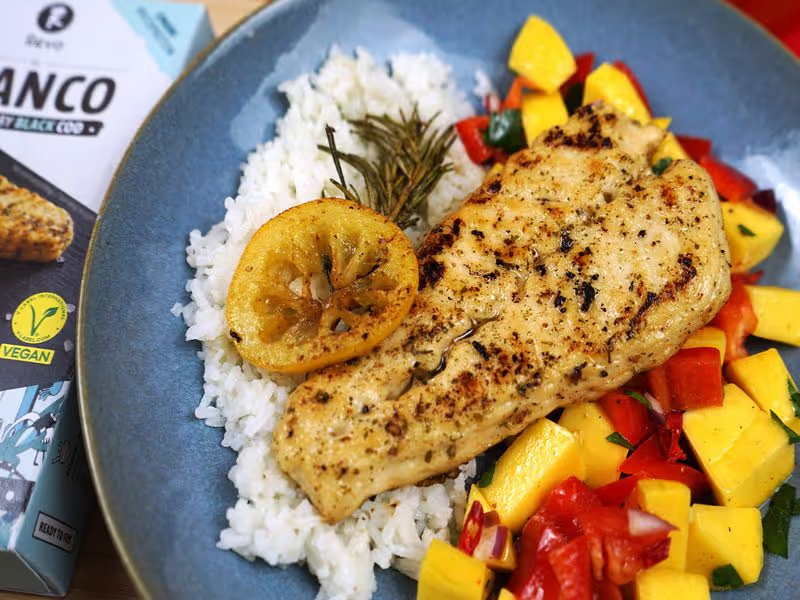
Cod alternative EL BLANCO. Image courtesy of Revo Foods
Austrian food technology company Revo Foods has released EL BLANCO, a 3D-printed, vegan alternative to black cod. The startup created its latest fish fillet by combining mycoprotein, microalgae oils, and 3D extrusion technology to produce an authentic alternative in both appearance and texture.
The product is manufactured using a high-throughput 3D extrusion system, which structures the mycoprotein into aligned fibres and incorporates fats into the protein matrix, which results in a layered, flaky texture. The (not-)fish is high in Omega-3 fatty acids, granting it the original’s recognisably buttery flavour.
Earlier this April, we covered how AM is integrating into the maritime industry, improving sustainability and lessening environmental impact through the printing of all things on the sea.
But 3D printing’s scope extends underwater- with this innovation, Revo Foods could improve the sustainability of the seafood industry, as black cod is overfished. Revo Foods head of food tech Niccolo Galizzi elaborated further, saying that at the core of the company is the belief that “for real change, sustainability and culinary pleasure must go hand in hand.”
Quasicrystals Shatter Aluminium Alloy Abilities

Artist's concept of quasicrystals. Image courtesy of SciTechDaily.com
Metal 3D is an industry on the rise. The technology is being incorporated into the aerospace, automotive, defense, and maritime industries. Recently, researchers have discovered new atomic structures in 3D-printed aluminium alloys.
These are called quasicrystals, and could resolve problems associated with using aluminium in 3D printing. Once considered impossible, in April they were found in a 3D-printed aluminium alloy, portnetially revolutionising how we design aircraft and car components.
Fan Zhang, a physicist at NIST, found that the strongest versions of aluminium tend to crack upon printing, as it has to be heated well above its melting point, which alters its structure and properties.
Unlike regular crystals, which have regular, repeating atomic patterns, quasicrystals have a different organisation, with their structure filling the space, but never exactly reproducing the same pattern. They are solids with an ordered atomic structure that does not repeat periodically.
An organisation of atoms that is too regular can make alloys more brittle, as it facilitates internal slippage, but quasicrystals create zones that block this movement and increase the material’s resistance.
Quasicrystals exhibit unusual properties, such as high strength and low thermal conductivity, making this discovery an exciting one for metal 3D printing and engineering at large.
Cooling Systems for Zero-Emission Hydrogen Aircraft

Hydrogen-powered vertical take-off aircraft Vertiia. Image courtesy of Conflux Technology & AMSL Aero
Conflux Technology has partnered with AMSL Aero to develop 3D-printed heat exchangers for Vertiia, Australia's hydrogen-electric vertical take-off and landing (VTOL) aircraft. These lightweight, compact exchangers, inspired by Formula 1 cooling systems, manage the thermal demands of hydrogen fuel cells during flight, including high heat loads during take-off and landing.
The collaboration aims to enable Vertiia to achieve zero-emission flights over distances up to 1,000 km at speeds of 300 km/h. Having completed the initial design phase, the project is progressing to integrate a proof-of-concept cooling system into Vertiia's powertrain, with hydrogen-electric test flights planned for later this year.
Elsewhere in AM and sustainability this month, Continuum Powders has achieved a 99.7% reduction in carbon emissions in nickel powder production by utilising its proprietary Greyhound M2P plasma atomisation process. This method converts 100% scrap metal into high-performance powders without remelting or chemical adjustments, lowering energy consumption and environmental impact compared to traditional virgin nickel production.
About AMFG
Across many industries, AM is being taken seriously– make sure your company is prepared.
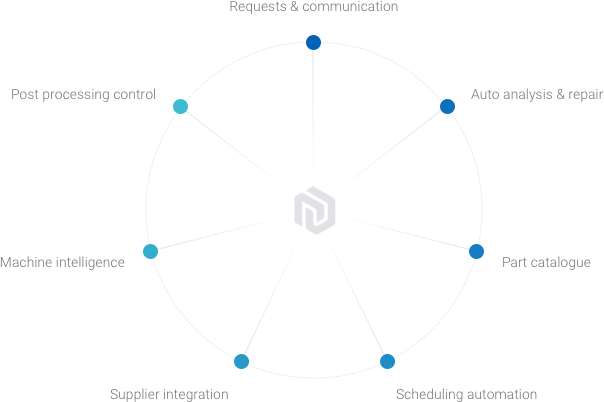
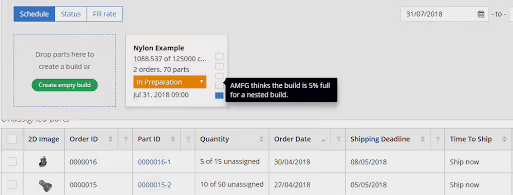
AMFG is an award winning MES designed to empower production workflows, from order placement to shipment, with seamless integration and precision automation.
With over 500 successful implementations in 35 countries and across a range of industries, we specialize in enabling companies to successfully integrate our software for AM and CNC production, into their wider manufacturing processes and scale their AM operations.
For more information, please contact us here: Book a demo


.avif)


.svg)

Subscribe to our
newsletter