Can Automation Help Make Reshoring a Reality?



The drive to reshore manufacturing is changing the industry’s landscape, and some shops are struggling to adapt. Political uncertainty, insecure supply chains, and convenience, are often pointed to when discussing the reasons behind reshoring. But while it brings many advantages, complete reshoring is hampered by a growing skills gap, and a lack of funding. So what are the exact details, and how can machine shops reap the rewards of reshoring without getting burned?
Why Should We Reshore?
In the current climate, companies are worried about changing tariff environments and geopolitical risks. In addition, global supply chains can be upended without warning (looking at you Suez Canal) which can be catastrophic for small-to-medium sized companies and shops.
By reshoring, companies are protected from any changes in tariffs or global supply chains, they reduce their transport and duty costs, and they have the convenience of having engineers located close to the manufacturers. This also provides the competitive advantage of being able to take on jobs with a short turnaround time, and increases the possible response times to customer demands.
Who’s Reshoring Already?
GE Aerospace announced this year they are planning to invest almost $1 billion into their US factories and supply chain, with plans to hire 5,000 US workers including manufacturers and engineers. Half of this investment is earmarked for developing new or existing facilities across a range of states to expand GE’s capacity, enabling them to improve their quality and efficiency as a company. The announcement has been well received, and looks set to improve external supply chains through continued investment, benefiting the wider U.S. economy.
Apple recently announced its American Manufacturing Program (AMP), which has increased their financial commitment to U.S. manufacturing to $6 billion over a four year period. Apple’s aim with the AMP is to accelerate manufacturing in the U.S. by partnering with a range of U.S. suppliers. The company will also focus on moving more of their supply chain and advanced manufacturing back to the U.S.
The covid-19 pandemic revealed how fragile the global supply chain can be, and in response Ford has focused heavily on bringing their manufacturing processes back to the U.S. Their consistent investment has strengthened their supply chain, enabled them to continue supporting the development of new vehicles, particularly EVs, and increased their capacity across the U.S.
Reshoring means that companies have stronger supply chains, increased capacity and efficiency, and they support the local communities economy. It’s a win/win situation for everybody, so why isn't it more widespread?
Why Isn’t It Done Already?
While many companies promise to reshore, very few have actually delivered on this pledge. Uncertainty is a reason to reshore, but it also contributes to hesitation when investing in new supply chains. Building facilities to reshore takes a significant amount of investment, and companies are unwilling to risk this in an uncertain environment. In addition to building the facilities, sourcing all materials locally is often difficult, making it impossible to properly reshore as part of the supply chain is still based offshore.
These are problems, sure, but the two main issues that are really putting a spanner in the reshoring works are a contraction of foreign direct investment (FDI) and the global skills gap.

FDI
As countries like the US become more focused on reshoring, international companies are looking to invest in production facilities located within the US. This provides the foreign companies with the same advantages as US companies (reduced geopolitical risk, lower transport costs, and secure supply chains) but it also increases their credibility with US based customers.
The industrial equipment sector has seen a huge amount of foreign investment, and from October 2024 to April 2025, two thirds of all foreign capital invested in US projects were related to semiconductor projects. However, FDI has been shrinking in recent years, making it difficult to finance reshoring projects.
The Skills Gap
In addition to uncertain funding, the global shortage of highly skilled workers in manufacturing is hampering the efforts to reshore. Current projections indicate that if the skills gap remains as it is, reshoring will actually increase the number of unfilled manufacturing jobs.
Even if the skills gap were closed, companies would face the issue of increased labour costs, as workers in the US would require higher wages than those in China or competing countries. Some companies may be able to swallow this increase, but many smaller shops would be forced to pass this on to their customers, resulting in higher prices.
However, many shops and companies are willing to take on this cost in order to reshore, and in a recent survey OEMs reported that having a highly skilled workforce located in the US would encourage 30% more reshoring efforts.
Unlike many companies, Contract Manufacturers have shown they are serious about reshoring, with 59% reporting that they have reshored, are actively doing so, or are quoting reshoring costs. Many shops have found that the reshoring drive has drastically increased the number of RFQs they receive, but given the skills gap shops are now in the envious position of having too much work, and not enough workers.
Closing the skills gap is the main priority, but in the meantime, what can shops do to take advantage of the RFQ tidal wave, without passing on higher costs to customers or turning away work?

Automation Software
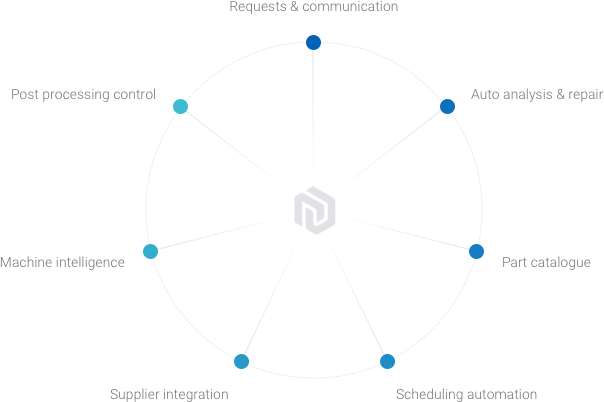
The first responder to an RFQ is usually the one who wins the job, and with a steady stream of requests, speedy quoting is now a strong competitive advantage. By using automation software like AMFG’s rapid quoting tool, shops can relax knowing that every RFQ will be responded to immediately, and accurately, winning them more work with less hassle. It also means workers can focus on more important tasks, like actually fulfilling the requests, rather than wasting time struggling with a mountain of RFQs.
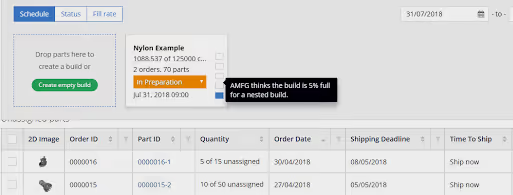
Automation is an easy solution to an immediate problem, and the ability to automate specific jobs can help shops reduce reliance on hard-to-find specialists, as well as providing an efficient way to win more work. It also means that shops don’t have to pay for more workers, meaning they can keep their original prices. While everyone else is hiring more workers, and passing that on to the customers, shops with automation software are working faster, more efficiently, and keeping their competitive pricing.
In the long run, for reshoring to be successful the skills gap must be closed. But for now, shops that want to take advantage of the new manufacturing landscape will find that automation provides them with an easy win.
About AMFG
AMFG works with high-mix, low volume manufacturers across the globe, streamlining their operations with our cutting-edge software platform. Our scalable tools automate all stages of manufacturing operations, providing automatic quoting and order management. Using our software, our clients can adapt to complex demand with efficiency and precision, securing their place at the forefront of the manufacturing industry.
For more information, please visit www.amfg.ai or contact: press@amfg.ai


.avif)


.svg)

Subscribe to our
newsletter