Additive Manufacturing Forecast 2025: Technology and Applications



We recently kicked off this miniseries by looking back at 2024, diagnosing it as a year of stability and restoration of trust in AM after a rocky couple of years. The technology and adoption to applications provided promising signs for 2025, but the market threw up some hiccups that prohibited comprehensive positive recovery.
In this article, we forecast the technology and industries that look the most promising for AM in the coming year. We look at systems and materials, the emergence of AI-based solutions, and a sustained focus on improving supply chain management and reducing cost per part.
We predict that healthcare and aerospace and defence will be the industries at the forefront of a positive year for AM continuing its recovery. Among emerging concerns, sustainability is a prime focus for companies as a way of reducing both the carbon footprint and cost per part.
Which systems and materials will be important in 2025?
In 2024, we saw the adoption of high-performance polymers due to their capabilities when resisting heat and stress, and the use of steel and titanium in industrial applications. Powder bed fusion (PBF) and directed energy deposition (DED) have become staples, and are being regarded as a solid manufacturing option in their own right.
The two dominant production methods continue to be selective laser sintering (SLS), a technique that uses a high-power laser to sinter small particles of polymer powder, and multi-jet fusion (MJF), which uses multiple jets to produce functional parts from nylon. High-performance polymers known for their strength are now readily accessible, permitting innovative designs and previously unfeasible applications in industries that demand high degrees of customisability and precision.
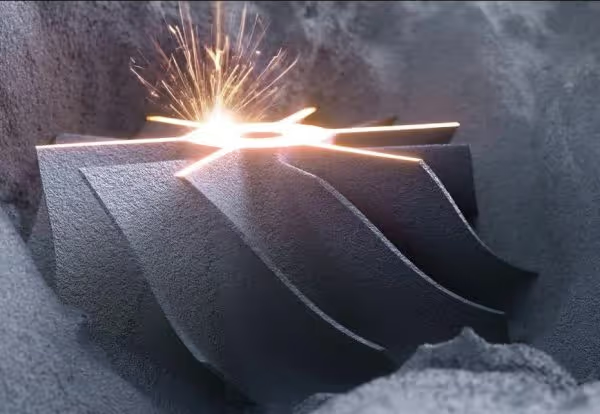
Selective Laser Sintering. Image courtesy of RJC Mold
Moving away from the polymer landscape, metal AM is ready to make a mark in 2025. Larger, established companies are generating serious plans to adopt MAM as a production method.
Selective laser melting (SLM) is estimated to experience significant growth between 2019-2029, establishing itself as the dominant force in the MAM landscape and placing it in a position to challenge polymer-based AM. Lightweight, strong, intricate metal components are being sought after by aerospace and defence, and with this increased demand, metal AM could have a very successful year.
A noteworthy trend in materials is the combination of different materials. For example, composites are those which mix the 3D printed plastic with fibres, an addition which increases the stiffness and strength of the produced part. Hybrid materials mix 3D-printed plastic with something completely separate, from organic materials, like cork, to products made of polyamides and aluminium powder, like alumide. This inclination towards combining materials could indicate a source of innovation for companies in the coming year.
New printing systems will revolutionise certain applications in 2025. For example, in healthcare, 4D printers already incorporate smart materials to create adaptive implants that respond to bodily stimuli, and can be used to produce devices like stents and heart valves. Bioprinting can be wielded to produce complex tissues and organs using bio-inks that are compatible with living cells, offering endless possibilities for producing human tissues and organs.
But the possibilities extend even further. 5D printers provide an even higher level of control over material orientation during printing, permitting increasingly intricate geometries. 6D printers enable sensor integration or interaction with external stimuli such as temperature or pressure within implants, a technology which could clear the way for smarter and more responsive implants. Given the potential the technology boasts, the healthcare industry may decisively turn to AM as the future.
What technologies will manufacturers use to scale?
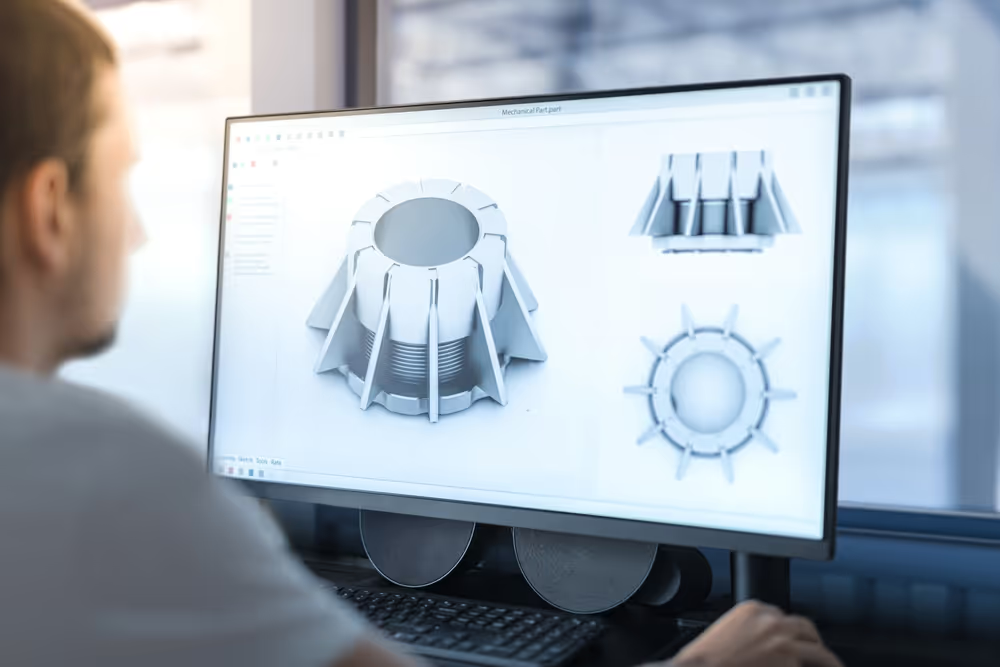
2025 will see manufacturers take a step towards significantly scaling up their operations.
Companies who leverage AI and machine learning solutions will be most prepared for the transition to scaled-up production. We are in the midst of Industry 4.0, and the use of AI and automation will aid the acceleration of AM.
AI for the sake of AI is set to disappear, with purposeful software being utilised to rethink and redesign production lines. Through predictive analytics, machine learning algorithms will be able to predict potential defects in new parts, thus lowering failure rates and improving product quality. At the initiation of the design process, generative design tools will become smarter and boast an improved level of accuracy, leading engineers to use AI to generate lightweight designs optimised for their purpose.
For example, dental laboratories will benefit from software automation, using it to address tasks that slow down production and rely on labour high in cost and low in availability.
Simulation will become essential to AM, replacing physical prototyping to some extent. Manufacturers can model temperature stress to produce parts that don’t warp or crack under extreme conditions, an important aspect of metal AM. New platforms will be able to accurately predict the behaviour of particular materials during the printing process and when used in different applications.
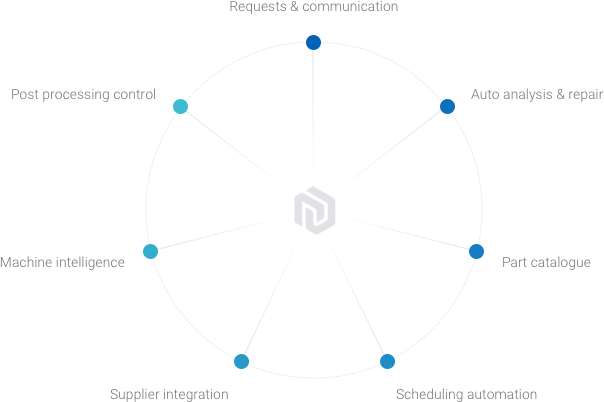
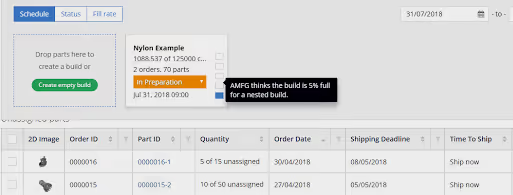
AI will also be leveraged in various solutions designed to decrease labour needs and increase productivity. MES software will allow manufacturers to manage their AM processes efficiently, scale up their operations and achieve full traceability across a more connected workflow. 2024 saw many companies turning to MES solutions; AMFG partnered with Toolkit3D to facilitate seamless workflows within the healthcare industry and allow customers to scale in digital manufacturing.
Technology-based solutions are permeating the manufacturing world, and additive is no exception. Embracing this software is a recipe for success in 2025.
Will AM be used for its benefits for the supply chain?
2025 could be the year that sees companies truly scale their supply chain to better meet customer needs. On-demand manufacturing and decentralised production could continue to be implemented, with more and more localised production hubs able to rapidly respond to changing demands, reducing transportation costs and enabling faster delivery in the process.
Distributive manufacturing has been touted as the future of AM for a while, but it’s up to companies in 2025 whether they choose to fully commit to such a radically different system of production. AM is naturally suited to customisation and ensuring supply chain resilience, so, in the coming year, successful firms will be those adaptable to customer demand and able to respond with speed and flexibility.
AMFG allows manufacturers to directly connect with preferred suppliers and subcontractors and enable on-demand, distributed manufacturing. Companies can easily outsource production, streamline communication, and effortlessly streamline shipping process- click here to find out more.

How will manufacturers drive down cost per part?
Several manufacturers have placed cost per part at the centre of the conversation for this coming year.
At Formnext 2024, several companies cited the importance of decreasing cost per part and improving printer productivity through improvements in software, sensors, and automation. To achieve this, sustainability has been highlighted as an area of improvement; minimising waste in polymer PBF printing and introducing new materials with a high refresh rate and new automatic powder recovery machines could be on the cards for 2025. Likewise, reducing virgin SLS powder and the creation of waste powder also decreases material cost for parts.
A Wohlers Associates report published in 2024 expects printer and post-processing technology to enable AM to scale up from thousands to hundreds of thousands of parts, and even million-part production runs for small components.
These scaled-up operations will drive down cost per part, and if automation and tools to increase efficiency are employed, then cost will sink even further and AM technology will bask in continued usage growth and new industrial use cases.
Why applications matter in 2025
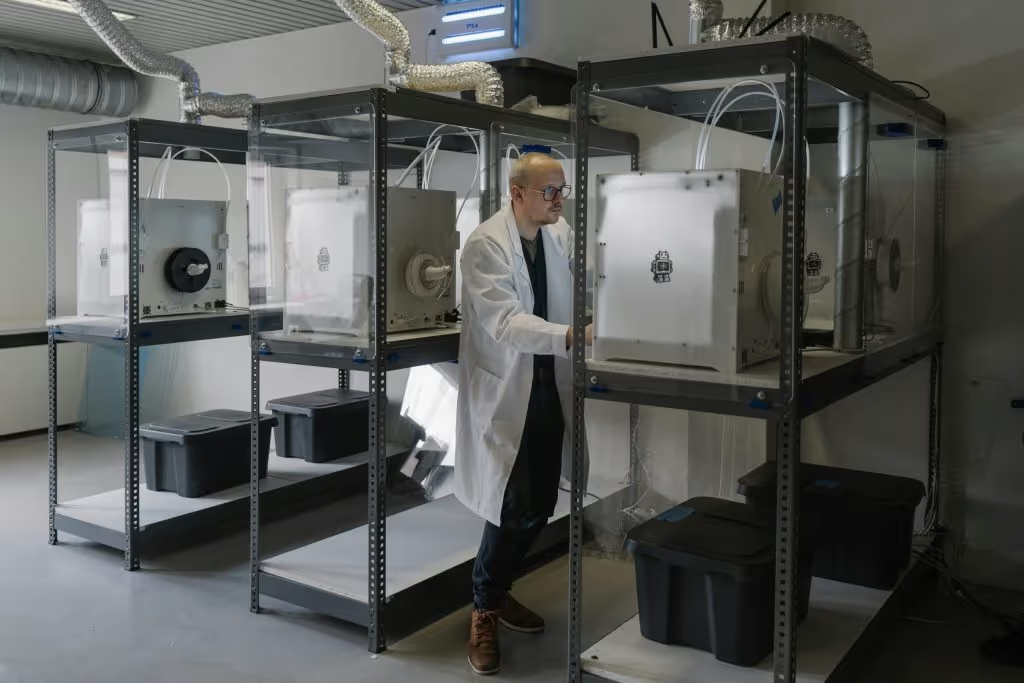
As our discussion of AM technologies demonstrated, the industry has left its nascence and is ready to be seriously considered in the manufacturing industry.
The prevalence of 3D printing in manufacturing and industrial component production is steadily increasing, with an enhanced focus on end-use parts and the aim of advancement into full-scale production. Industries are responding to this, and despite the reluctance generated by market insecurities in 2024, adoption in applications are a continuing positive trend going into 2025.
Phil DeSimone, CEO of printer manufacturer Carbon, described how AM is set for ‘application-driven innovation’. A company’s success will be defined on the extent to which they can provide practical solutions which directly improve people’s lives. Gone are the days in which AM was stuff of futuristic fancy or a mere tool for prototyping; the technology is being recognised and embraced as a practicable solution in a wide range of industries. In fact, market intelligence firm CONTEXT, in a report published in December 2024, gave a positive five-year projection for industrial 3D printer shipments with a forecasted 19% compound growth rate, given increased utilisation of AM in high-volume production applications.
So, which of these applications will come to the forefront in 2025?
Healthcare and dentalcare
The medical industry and additive manufacturing go hand in hand, so it’s no surprise that medical applications leading the way in 2025. According to GlobalData analysis, the healthcare 3D printing market is expected to achieve a compound annual growth rate of 17.5% between 2024 and 2029.
The healthcare sector has demonstrably embraced AM for bespoke devices that require individualised customisation for patients, ranging from dental implants to prosthetics and orthotics. This natural affinity is founded on AM being able to customise solutions with a level of personalisation that just cannot be achieved with other methods of manufacturing. Similarly, AM can help shorten production timelines, optimise surgical procedures, and significantly reduce postoperative complications.
Beyond continuing the steadily increasing trend of the adoption of AM in medical applications, 2025 also promises a great deal of innovation in this field.
January also saw companies leveraging AI in healthcare applications, like Illinois-based Hike Medical, who applied machine learning to the production of insoles. Users scan their feet using a mobile app and receive a custom pair of insoles 7-10 days later.
VOXELTEK also demonstrated the power that AM possesses to crack the key problem in healthcare and dental care: waiting time. The Hungary-based developer has introduced a system allowing dentists to complete treatments within a single visit, integrating scanning, design, and printing to create dental applications in less than an hour.

VOXELTEK printed restorations 2 copia 780x470.jpg
Yet there may be some barriers to widespread adoption moving forward. AM for medical devices has high entry costs, with multi-laser LPBF machines rising above €5 million in some instances. There are also rigorous safety and efficacy standards that 3D printed medical parts need to meet, so manufacturers must overcome these regulatory challenges.
Nevertheless, the healthcare industry will continue to incorporate AM technologies in 2025, with innovation being a driving force.
Aerospace and defence
AM looks set to continue flying high in aerospace and defence in 2025.
The technology is now producing end-use parts that will be employed in industrial contexts, and aerospace and defence are at the front of the queue.
The renewed interest in AM from these sectors is rooted, as in the case of healthcare, in the unique capabilities that the technology enables. Hamid Zarringhalam, CEO of Nikon Advanced Manufacturing, describes how AM can help address ‘gaps in the defence industrial base … that are very difficult to try and address with conventional means’.
As an illustration of this, we can turn to Australian metal 3D printer manufacturer SPEE3D’s success in proving its Expeditionary Manufacturing Unit (EMU) has the capacity to operate in sub-zero temperatures. In January, they took part in the US Department of Defense’s ‘Point of Need Challenge’ and demonstrated their technology’s ability to perform well in extreme weather conditions, after previous collaborations with the Australian army in which the EMU functioned in the extreme heat of the Australian bush.
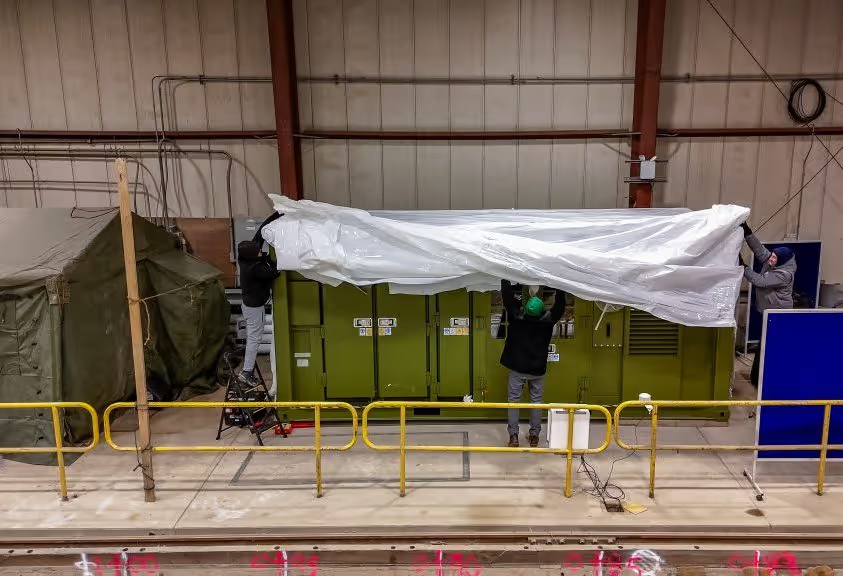
XSPEE3D being set up for cold testing in CRREL location. Image courtesy of SPEE3D
Defence agencies are recognising the groundbreaking implications on supply chains that AM harbours, with the possibility of leapfrogging entire steps in supply chains becoming ever more plausible. This is essential in a sector like defence, which necessitates agile and flexible chains of production, and could be transformed through manufacturing in the field.
But the benefits of 3D printing are not just limited to their abilities to surpass steps in the supply chain. In the past few years, the aerospace and defence industries have helped prop up the AM market as a result of interest in the technology itself.
The inherent benefits of additive manufacturing for the sector are numerous: in aerospace, AM has had a hand in the reduction of fuel consumption and emissions by producing lighter components that are simpler and more sustainable to produce. The need for lightweight, high-performance parts in modern aircraft and spacecraft is propelling the adoption of AM, as it enables optimised designs unachievable by traditional methods. The expected CAGR for the aerospace industry from 2023 to 2030 is 18.3%, so it’s not unfair to predict that there will be a clear appetite for AM in the industry in 2025.
Yet, like medical applications, there are some challenges. Knowledge gaps when making the transition to additive technologies and cost of industrial printer implementation threatens the positive outlook for AM in aerospace and defence, as does potential congestion of 3D printing workflows and required adherence to regulatory standards, such as ITAR and AS9100.
The right digital infrastructure can ensure that companies maximise efficiency and optimise operations. While working with Babcock for the UK Ministry of Defence’s Project Tampa, AMFG’s MES software helps combat part obsolescence, improving contingency plans and readiness of UK front line commands.
Amidst the possibility of another space race under a Trump presidency, international conflicts, and increased investment from governments, 2025 should be a promising year for AM in aerospace and defence; companies should ensured they’re prepared to capitalise.
Which industries will emerge in 2025?
Automotive
The automotive industry has historically partnered with AM, and this will be no different in 2025. Solutions like complex sealed connectors and custom vehicle components indicate a renewal of this strong bond. Supply chain congestion once again risks this potentiality, however, so companies are looking to solutions; 49% of automotive companies are already investing in digital, smart factories.
Marine
Similarly, the additive marine industry may be set for a boom in 2025. With faster, more efficient production of large components like custom interiors, dashboards, bespoke extensions, and propulsion systems, reduced lead times and costs will encourage further growth in the sector.
Sustainability
Perhaps one of the central emerging focuses in the New Year is sustainability. More companies are considering implementing sustainable materials and processes, with bio-based products and materials driving down (the already inherently lower) carbon footprint of 3D printing.
However, the energy-intensive nature of metal powder production and electricity-hungry high-powered lasers pose some problems. Some companies are exploring renewable energy sources and more efficient recycling methods to mitigate this and help AM to evolve. Although Donald Trump has rolled back climate regulations in the US, manufacturers who export to the EU will still be expected to comply with EU environmental regulations, and certain states will keep these rules in place- particularly after the recent fires in California.
R&D
R&D may experience a downturn in popularity, with the beginning of a departure from academia; AM has proven its potential as a technology, and this potential is now being converted into widespread applications. The focus will be on scaling up manufacturing operations and catering to higher-volume customers on a global scale, establishing new, application-based workflows for serial parts.
In 2025, AM services will be more important than ever. Despite receiving limited coverage compared to hardware, software, and the products themselves, AM services totalled $1.9 billion in Q3 2024, reflecting a 14% year-over-year increase. Companies are looking to services like AMFG to improve cost efficiency and timeliness, manage workflows, and achieve streamlined, automated processes. Click here to find out more: Book a demo
Final thoughts

Successful companies in 2025 will monitor these developments, apply the technology to focused areas of the market, and solve specific customer problems, rather than balancing multiple approaches.
But this isn't the end of the story.
Industries are hungry for the technology, but without significant interest from investors and sturdy market conditions that encourage adoption, AM is likely to linger in the ‘trough of disillusionment’ in which it has been mired the last few year.
In the next article in this miniseries, we will take a look at market predictions for 2025, and whether a good year lies in store for additive manufacturing.
Contact us by clicking the button below to receive the next two parts or speak to an expert about how to succeed in additive manufacturing in 2025.


.avif)


.svg)

Subscribe to our
newsletter