3D Printing Mass Production: 8 Success Stories


3D printing has historically been regarded as a production method for low volume parts, the reasons why this is true– customisability, sustainability, efficiency, traceability– are not exclusive to smaller part runs.
From finding a niche in certain medical applications, to bolstering supply chain integrity, firms across the world are using the technology for big batches.
In this article, we’ll explore why companies opted for AM when producing en masse, and how they managed to scale up to thousand-and-million-part runs.
Adidas
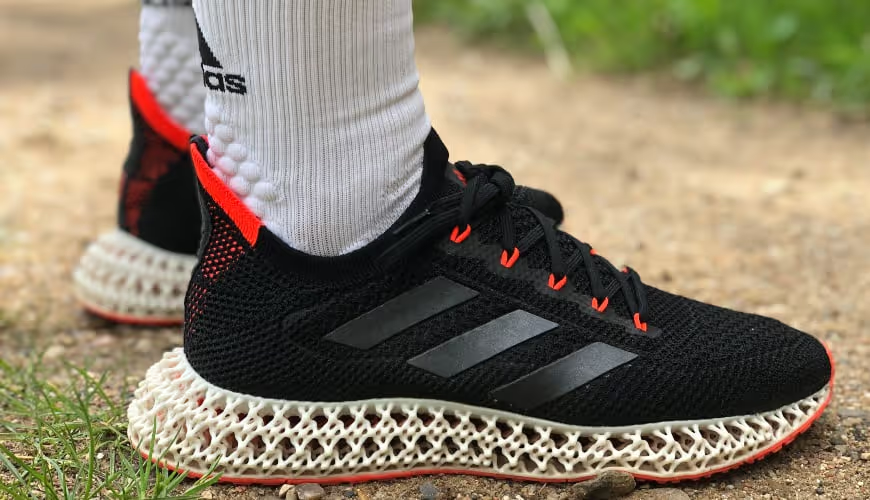
The German sports giant is no stranger to 3D printing. In 2017, the company, along with Carbon, released 100,000 pairs of the Futurecraft 4D, a single-print mid-sole, later followed by AlphaEDGE in 2018.
But 2021 saw the biggest release yet: the Adidas 4DFWD, the world’s highest volume 3D printed shoe with over 2 million sales. The product has a unique lattice model which translates vertical impact forces from a runner’s downward step into forward momentum.
The shoe is printed with the Carbon DLS process and utilises the EPU 44 elastomer, a highly resistant and more sustainable material. The design of the shoe is impossible with other technologies, showing that if there’s a use case for AM, it can be applied on an industrial scale.
Erpro

Le Volume Révolution by Chanel, produced by Erpro.
With over 20 million parts delivered between 2018 and 2024, Erpro’s collaboration with Chanel is exemplary of the technology’s suitability for mass production.
Both Le Volume Révolution and Le Volume Stretch are additively manufactured, as Erpro is able to deliver a unique shape impossible with other technologies. The extremely precise shape of the brush features five sets of bristles implanted in an ellipse with a hollow core, a brush shape impossible to achieve without 3D printing technology. Users are able to choose their mascara brush from 10 models on a tablet application, demonstrating how AM permits personalised, mass produced goods.
Achieving industrial production to this scale doesn’t happen in a vacuum, however– since 2023, AMFG has worked with Erpro to optimise workflows and speed up quoting across AM, CNC, and injection moulding.
Airbus
For over 10 years, every new Airbus A350 XWB has included 3D printed metal components, including brackets to help secure the connection between the plane’s wings and engines. In 2015, long before additive manufacturing was seriously considered as a legitimate method of mass production, Stratasys provided more than 1000 printed parts on the aircraft.
Behind this decision is the desire to have more comprehensive control over the supply chain, vertically integrating the production process to accelerate retrofitting in an industry in which time is of the essence. Likewise, as Addinor identifies, medium-volume metal AM is more cost-effective than traditional options, as the intricacy of the part necessitates high levels of waste when using subtractive processes.
Sonora
3D printing has revolutionised hearing aid production. Early innovators Sonova implemented AM for hearing aids at the beginning of the millennium, and soon other companies followed suit. Nowadays, 3D printing is the sole method of manufacturing, and Sonova holds a hefty share of the market (31% in 2019).
Sonova have printed over 50,000 parts, including shells for custom in-the-ear hearing aids, various custom earpieces for behind-the-ear, and receiver-in-canal hearing aids. From an early date, Sonova recognised the potential that customisability brings for business, and took full advantage.
Monoqool
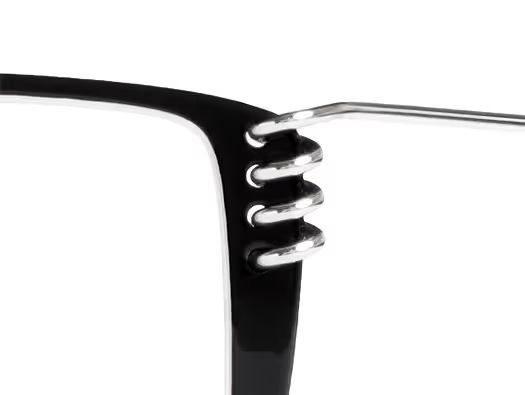
Screwless eyewear by Monoqool
From ears to eyes, Danish eyewear gurus Monoqool have made waves in the mass production of 3D printed eye glass frames.
The frames are lightweight and screwless, having been sintered as a single piece from a polyamide powder. Each frame consists of 400 ultra-fine layers, and thanks to a clever spiral hinge, the eyewear does not require screws, welding, or bolts.
The final product, which weighs a mere 4 grams and has been fabricated over 2000 times, can be easily adapted according to trends in eyewear– fashion is fickle, but Monoqool has the fix.
Align Technology
There may be no greater AM success story than Align Technology and its flagship product, Invisalign. Recently, the company celebrated surpassing 14 million customers, providing customer dental models for aligners.
Although the aligners themselves are not 3D printed, the models of each patient’s teeth used to create the custom Invisaligns are. 3D printing is used by Align Technology for everything from molds for its flagship aligners to a palatal expander, the first direct 3D printed orthodontic device from the manufacturer.
Align Technology have managed to scale up to staggering levels of production by recognising the potential benefits of combining customisation and mass production.
Daimler
Some companies have implemented additive manufacturing not for design capabilities but rather to unlock distributed manufacturing. Daimler Truck is one of the world’s biggest commercial vehicle manufacturers, and in early 2025 they launched an automotive serial AM program for local production of spare parts.
In a collaboration with 3D Systems, the solution enables 3D printing parts to manufacture a variety of spare parts on-site, such as underhood components and cabin interior elements including pins, covers, and inserts.
Local supply chain infrastructures and inventories have limitations that may result in weeks of delays, but Daimler’s solution promises to cut the time required to obtain parts by up to 75% and deliver a more efficient spare part supply workflow through decentralisation.
Cobra Golf

A 3D printed putter by Cobra
Cobra Golf mass produces a family of 3D printed putting models, pushing the envelope for sports equipment manufacturing.
The King 3D printer putter family included an oversized blade model, a fang-shaped model, and a mallet-style putter, all of which leverage a 3D printed nylon lattice cartridge that forms
By using HP Metal Jet technology, Cobra Golf boasts an unprecedented level of design freedom, scaling up production (over 30,000 parts have been printed) whilst maintaining high quality.
The story behind the success
We’ve seen the success. But how did those companies get there?
In manufacturing of any persuasion, efficiency is key. Firms don’t reach millions of parts produced without ensuring their operations run perfectly smoothly. MES solutions can be instrumental for companies looking to scale.
AMFG works with companies like Erpro, HP, L’Oréal, and Volvo to help make sure their production runs smoothly, no matter the size of the orders.
About AMFG
AMFG works with high-mix, low volume manufacturers across the globe to streamline their operations with our cutting-edge software platform.
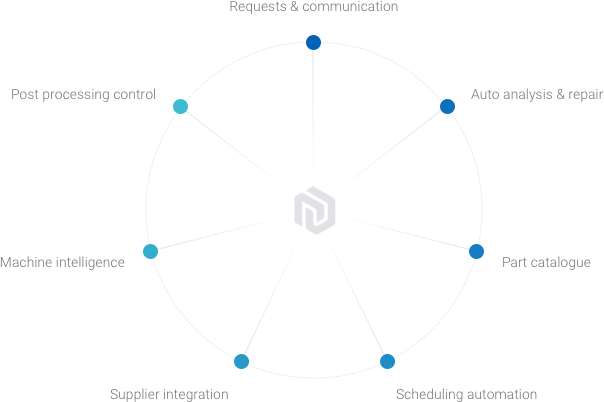
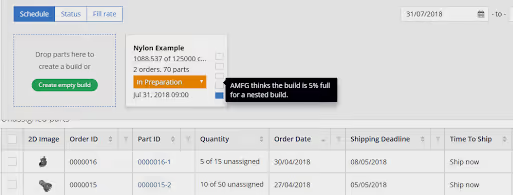
Our scalable tools automate multiple stages of the manufacturing operations, providing automatic quoting, reducing human error, and cutting down on monotonous admin work, while maintaining the highest level of data security. Book a demo
Read our interview with Cyrille Vue, CEO of Erpro, here


.avif)


.svg)

Subscribe to our
newsletter